Thursday, May 29, 2014

Miss Piggy's Nose

Odd how the mind works. I had lunch with a woman friend I’ve known since my first, earliest days in Chicago, when I was still in my 20s and Norm and I were together. It got me thinking of Norm, as I do from time to time, and about everything that was involved in dealing with the death of someone close who had, in his last days, become increasingly dependent on me. 

As executor of Norm’s will, it was my responsibility to dispose of his personal property. He had, at the time of his death, lived in the same condo 40 years, and therefore had 40 years of "things"...some quite valuable, others just the "things" one accumulates over the course of the years.

After having packed and given away all his clothes, which alone filled 13 garbage bags and 2 or 3 cardboard boxes, I moved on to the smaller, miscellaneous, hard-to-categorize items which are part and parcel of every life.

In the bookcase in his den I found a Day Planner for 2002, apparently never opened, and a like- new two-volume Funk &Wagnall's Dictionary. There was also a very nice brick, apparently used as a door stop. There were several shelves of gardening and horticulture books, some of them obviously quite expensive when purchased. The fact that Norm enjoyed plants and at one point went to school for some sort of degree in horticulture is not coincidental to the fact that Jonathan Quinlan, Dick Hardesty’s partner in my Dick Hardesty Mystery series, loves plants and has an associate's degree in horticulture.

Probably as a reflection of his interest in plants, various closets held four huge and expensive ceramic planters, along with at least a dozen others of varying sizes. There were walkers and seats for the shower and bathtub which have never been used, reflecting his declining health. One tub chair still had the price tag ($145) attached. 

And yet what was I to do with them? A yard sale in a 35th floor condominium was a bit impractical, and even if it were practical, the time to price each item would have been unimaginable. So I called in an art appraiser to give me an idea of the worth of some of the more valuable pieces, and hoped he might direct me to a source of potential buyers. He did not. I then looked for estate buyers—those people who buy the entire contents of a home or apartment—to handle the rest. I found they pay only a tiny fraction of the value of what the items would bring if sold separately—literally pennies on the dollar. Some said they would take most of it but would charge for the privilege. Anything broken or worn, they refused to take, leaving it to me to have taken to the dumpsters on the building’s main floor.

And through it all, I never forget that ever single thing I was charged with disposing of was Norm's, not mine, and I couldn't help but feel guilty…as though I were treating it all as if it didn't really matter; as if it all were just a bunch of things. It's as if each item had existed in some sort of vacuum and had nothing to do with the real person who bought and enjoyed them.
In a drawer in his den, along with several decks of playing cards, a lint roller, the remote control for a long-gone television set,  a couple rolls of film, six crystal balls of varying sizes apparently once part of a chandelier, a badly dog-chewed tennis ball, and a number of other things, most of which I was unable to identify, I came across Miss Piggy's nose. It was a perfectly good nose, made of pink rubber, with a thin elastic strap that fit over the back of the head to hold the nose in place. And I realized that it, like everything else in the drawer, had not simply appeared there out of nowhere. Norm put it there for whatever reason, and again like everything else there, it had at one time served some purpose, and meant enough to him to keep it.

But eventually I got rid of everything…things I knew he loved along with those to which he was probably totally neutral, and eventually my sense of guilt diminished. Things are just things.

But oh, Miss Piggy's nose.... 


Dorien's blogs are posted by 10 a.m. Central time every Monday and Thursday. Please take a moment to visit his website (http://www.doriengrey.com) and, if you enjoy these blogs, you might want to check out Short Circuits: a Life in Blogs (http://bit.ly/m8CSO1), which is also available as an audiobook (http://www.audible.com/pd/ref=sr_1_1?asin=B00DJAJYCS&qid=1372629062&sr=1-1)

Monday, May 26, 2014

Name Dropping

While I always find name droppers mildly annoying, I realized the other day, while talking with an English friend (drop #1) I met on my last year’s cruise from Rome to Istanbul (drop #2) about the possibility of his joining me and my friend Gary on our August Venice to Athens cruise (drop #3) that I am one of them. Actually, I’m far more of a place-dropper than a name-dropper, but the annoyance factor is potentially the same.

My defense is that I do it not so much to impress others as to convince myself that neither I nor my life are quiet as dull and uninteresting as I have told myself all my life. I have never liked myself very much and have always thought of myself as the epitome of “vanilla”…nothing outstanding or of any particular interest to anyone, including myself. 

But when I can step away from myself and look at my life as though it were not my own, view it  from the perspective of the little boy who still lives somewhere inside me, I find an odd form of validation and reassurance that I’m not as dull as I think I am.

There have been moments of true euphoria in my life…moments so marvelous to recall that they send me into a state of wonder: Soaring alone through the clouds  as a young naval aviation cadet; rediscovering, after nearly 60 years, a battered quay in Cannes, France I so strongly associate with the happiest week of my Navy service; sitting on a beautiful April day in front of a cafe in Piazza San Marco in Venice, having a beer while an orchestra plays songs from old movies; sitting on a broken column in the courtyard of a villa in Pompeii, listening for the whispers of people dead 2,000 years. Me! I did these things!

I have friends who routinely travel from Saskatchewan to Kenya, from England to Japan, from Florida to Thailand. I read books of peripatetic adventurers who constantly move from one amazing adventure to the next, and see movies in which the wealthy go casually and effortlessly from exotic hotel in Dubai to equally exotic castle in Spain, or cross the ocean on a small sailboat. And I realize that no one human being can do all these things simultaneously. One cannot live in a snow-covered chalet on the side of a Swiss mountain and attend an opening of the Paris Opera at the same time. But the implication from all forms of media is that they do.

I’ve been to London once, Paris, Cannes, Athens, and Istanbul twice, Rome three times; Venice, Nice, Florence, Sorrento, Capri, Budapest, Vienna, Amsterdam, and a dozen or more places most people never get to see. Granted, I did not spend all that much time in any one place, but I was there! And with the upcoming trip, I’ll be back in Venice and Athens with half a dozen or more new places. Liza Minelli, in her album, Liza with a Z, sings “Ring Them Bells,” in which there is the line, “Be sure you see Dubrovnik, dear, before you come home.” Well, I’ll be seeing Dubrovnik. 

This next trip will quite probably be my last European adventure. I’ve seen most of what I’ve wanted to see there and, at 80 (odd how there are so many things I can say and yet cannot comprehend), my body, upon which I have depended for so long and which has served me so well, is simply getting to the point where, like any machine or living organism, it can’t do everything it once could. 

But like a squirrel storing up nuts for the winter, I have accumulated and will continue to accumulate enough positive memories to sustain me through the long winter and whatever lies beyond.

Dorien's blogs are posted by 10 a.m. Central time every Monday and Thursday. Please take a moment to visit his website (http://www.doriengrey.com) and, if you enjoy these blogs, you might want to check out Short Circuits: a Life in Blogs (http://bit.ly/m8CSO1), which is also available as an audiobook (http://www.audible.com/pd/ref=sr_1_1?asin=B00DJAJYCS&qid=1372629062&sr=1-1).


Thursday, May 22, 2014

The Candle

Please believe me—I do not want to become a bitter old man muttering oaths under my breath and swiping at passing children with my cane. But I am sincerely growing increasingly concerned about how bitter I am becoming. I don't want to turn into a nasty curmudgeon people cross the street to avoid. But it's like being in quicksand: the harder I try to free myself, the further in I sink.

Perhaps it is just that bad things weigh more heavily on the mind and sprit than do good things and tend, with every passing year, to become more and more the consistency of hardening concrete.

How can I—how can anyone—escape being aware that we are becoming a society utterly consumed by a pathetic fascination with the rich, the beautiful, and the famous? Our worth as individuals—often in our own eyes—is measured against those three criteria: wealth, beauty, and fame. A "celebrity" suffers a hangnail and the world gasps in horror and shock. Flowers and messages of support pour in. Mary Jenkins, a supermarket clerk in Olathe, Kansas, is brutally murdered in her home in front of her children and the news doesn't make it past the next county.

Have I been under a rock for the past ten years? Who the hell are these people who rule our popular culture--these preening, posturing poseurs whose unknown talent totally escapes me? What constructive, positive things have they ever done to help improve humanity? Why should their peccadillos, their divorces, their scandals interest me in the least? (Well, they don't, of course, but surely, surely I have to be missing something, somewhere!)

Why are we glued to "reality" shows—awash in vacuous young rude, obnoxious foul-mouthed—but filthy (the operative word) rich bimbets and with flawless skin and perfect teeth but with a heads so hollow you can almost hear a the wind whistling between their ears—which couldn't possibly be farther from reality? Why do people listen to—and far, far worse, obviously totally believe—the purveyors of ignorance, bigotry and hate posing as "political analysts," pundits, and talk-show hosts on egregiously un-fair and un-balanced media like Fox News?  (Actually, Fox occasionally displays some bitter humor. You can be sure, for example, if, when reporting on a home-grown terrorist, they discover that the perpetrator's great grandfather had voted Democratic in the 1928 election, it will be brought out as incontrovertible evidence of guilt.)

The problem is that it is so hard not to be bitter when things that should be so simple and self evident are twisted and skewered and turned inside out at the whim of anyone with a perceived axe to grind. Becoming bitter is a particular danger for romantics, who really want and fully expect to see goodness and courtesy in others and who never really develop the rhinoceros hide most people don in order to deal with the world. The more one yearns for a world of puppies and cocoa with marshmallows, the more prone one is to be disappointed and hurt by gratuitous evil. 

The seeds of bitterness grow slowly, but the trees that spring from them are almost impossible to fell. And worst of all, there is no joy, or hope, or promise in them.

And yet, for all my very real concerns, for all my inability to comprehend why the world works the way it does, or why there is so much soul-crushing stupidity and bigotry and greed and so little compassion and common courtesy, there remains, underneath the accumulating layers of cynicism and distrust which threaten to smother me, the belief in good and our ability to somehow...somehow reverse all this negativism; to somehow put the genie back in the bottle.

And as long as humanity has hope, however unrealistic it may seem, we will survive. For in the raging tempest of existence, hope is our one small, inextinguishable candle providing a beacon in the vast night.


Dorien's blogs are posted by 10 a.m. Central time every Monday and Thursday. Please take a moment to visit his website (http://www.doriengrey.com) and, if you enjoy these blogs, you might want to check out Short Circuits: a Life in Blogs (http://bit.ly/m8CSO1), which is also available as an audiobook (http://www.audible.com/pd/ref=sr_1_1?asin=B00DJAJYCS&qid=1372629062&sr=1-1).

Monday, May 19, 2014

"Mine Enemy Grows Older"

It’s not often one gets to make reference to raconteur Alexander King, Walt Kelly’s Pogo, and Dorothy Parker in the same sentence, but I’ve managed. The title of this particular blog is taken from King’s 1958 book of his personal observations on aging. That I and so many others appear to look upon aging as continuing battle brings me, of course, to Walt Kelley’s marvelous comic strip character’s astute observation that “We have met the enemy, and he is us.” Which, in turn, sparked the memory of a classic exchange in the long-running feud between the inimitable Dorothy Parker and socialite Clare Both Luce. At one point, a friend said to Dorothy, about Clare “But you know, Dorothy, Clare is her own worst enemy,” to which Dorothy replied, “Not as long as I’m alive, she’s not.” Scotch-tape the references together, and you have the story of my life.

I am and have always been my own worst enemy, my bitterness against aging and against myself easily rivaling the enmity between Parker and Luce. It stems from the fact that, all evidence to the contrary, I am a perfectionist. I can and do accept flaws in others that I cannot and will not tolerate in myself. Actually, it is a particularly perverse form of hubris. A great part of me has never matured beyond the child’s assumption that he is all-powerful, and that everything that happens in the world is somehow related to him.

As a result, I am incredibly easily frustrated when something—anything—does not go as I think it should. And when that something directly involves me, frustration often quickly spirals totally out of control, sending me into a self-directed rage.

Though I’m not a psychiatrist, I would suspect that masochism, the self-infliction of pain, has a mental component, and I fully if regrettably see that quality all too clearly in myself. I am constantly measuring myself against others and falling far short.

Regrets are a part of the human condition; we all have them, and they cause us a great deal of suppressed sadness and pain. But for the mental masochists among us, the emotional scabs which inevitably form over the incident are constantly being picked at and reopened.

I can clearly recall embarrassments and shames experienced from childhood and throughout life, and they often for no reason I can determine suddenly pop into my head. I can also recall too clearly the pains I have caused others; the things I should have done that I did not do; the careless and thoughtless things I would give anything to change. And, of course, these flaws build up over time like the individual snowflakes in a life-long snowstorm. The older I get, the more oppressive they seem.

So why, exactly, do I insist on dragging out all the skeletons in my closet and frantically waving my dirty laundry in front of you? Perhaps as a part of the mental masochism thing, but I would prefer (I am also very good at self-delusion) to believe it is because, once again, I do not think I am the only human to have this problem. There are many things in life which, though common-to-universal are, like certain bodily functions, considered too private and personal to talk about. So I like to think I do it to assure others who feel the same way that they aren’t alone. It may simply be yet another form of self delusion but, hey, I’ll take it.

Dorien's blogs are posted by 10 a.m. Central time every Monday and Thursday. Please take a moment to visit his website (http://www.doriengrey.com) and, if you enjoy these blogs, you might want to check out Short Circuits: a Life in Blogs (http://bit.ly/m8CSO1), which is also available as an audiobook (http://www.audible.com/pd/ref=sr_1_1?asin=B00DJAJYCS&qid=1372629062&sr=1-1).


Thursday, May 15, 2014

Fretting

Of all the wasteful, unproductive, and frustrating pastimes we humans absolutely insist upon wasting our time, fretting surely has to be right there at the top of the list. I've come to the conclusion that fretting provides the same perverse form of pain/pleasure as picking a scab, and despite our protestations to the contrary, we must enjoy it at some level, or we wouldn't do it.

I'm quite good at fretting but, as with most things, not really a pro. Were college degrees offered in Fretting, I'd probably qualify for an associate's degree at best. My friend Gary, however, would have a double Ph.D with honors. I have no idea where he possibly finds all the things to fret about, but if they are there, he will seek them out. He's my best friend, and it's unfair of me to single him out, since he is far from alone. He is in fact only one of a vast number of people for whom the making of an appointment for a routine dental checkup three weeks in advance provides three rich weeks of fretting, though not even they are sure exactly what it is they're fretting about. Being a closet Obsessive-Compulsive probably helps. Full-time fretters rarely have housekeepers—they would fret so much about fearing to be thought untidy that they would clean the place from top to bottom (probably twice) before the housekeeper arrived.

I think I register so low on the Fret scale because I don't really give a damn about some of the richest veins of ore for fretting. 

Of course, fretting seems to be a part of the human condition, and there are times when it is both inevitable and understandable, as in the anticipation of physical, relationship, or financial crises. But even then fretting is less than worthless; it's counterproductive.  Fretting is Worry Lite; it's Worry on a caffeine buzz, and while worry can sometimes lead to conclusions and solutions, fretting almost never results in anything positive.

One of the worst things about fretting is its insidiousness; it's like inviting a vampire through the open window of your mind: once it enters, you're doomed, and applying logic and rationality have absolutely no effect. Even knowing full well that the anticipation is far worse than the event, and that once the cause of the fret...that dentist's appointment, say...is over, it simply goes away, like passing a kidney stone, and has no effect. We simply erase it from our minds and immediately move on to the next fret.

My total inability to control fretting once it has snuck into my mind is what I find most disturbing. I know it's pointless; I know perfectly well that whatever I'm fretting about will not only pass, but that once it's over I will wonder yet again why I'd ever wasted my time on it in the first place.

Animals don't fret. Whatever happens happens when it happens and that seems to be just fine with them. They might put up something of a fuss if they want to be fed, but I wouldn't call that fretting, necessarily...it's more a physical reaction to being hungry. I doubt they spend much time fretting about what time they'll have dinner and what might be on the menu. Even when animals have good reason to fret, they don't. I have yet to open a closet door without my cat immediately darting in as though he'd never seen it before, though he'd just been in there half an hour earlier. Once inside, he refuses to respond to my calls to come out, and I'm not about to get down on my hands and knees and go feeling around behind the laundry basket and stacks of boxes to try to find him. So eventually and inevitably I will simply close the door in frustration and walk away. Does he fret and worry that I will forget about him and that he may be in there forever? He may not fret about it but I inevitably do, wondering how long it will be before he begins a plaintive mewling to be released. The fretting mounts until I stop what I'm doing, go to the closet, and let him out until the next time. 

Fretting certainly does not respond to logic. We know it's pointless. We know that whatever we're fretting about will resolve itself one way or the other without the fretting. But still we do it.

A case of "simple pleasures," I guess.


Dorien's blogs are posted by 10 a.m. Central time every Monday and Thursday. Please take a moment to visit his website (http://www.doriengrey.com) and, if you enjoy these blogs, you might want to check out Short Circuits: a Life in Blogs (http://bit.ly/m8CSO1), which is also available as an audiobook (http://www.audible.com/pd/ref=sr_1_1?asin=B00DJAJYCS&qid=1372629062&sr=1-1).

Monday, May 12, 2014

"Under God"

To avoid being stoned in the streets, I suppose a caveat might be in order before we begin: the views expressed in the following blog are my views. You are under absolutely no obligation to agree with them. But I hope you might try to understand them.

When I was in the Naval Aviation Cadet program, trying to learn how to become an officer and a gentlemen, we were told frequently and in no uncertain terms that there were certain subjects absolutely forbidden to be discussed at mess (dinner): sex, politics, and religion. Probably good advice, since those three subjects are time-bombs all but guaranteed to blow up when a strong disagreement arises.

So when I recently saw yet another internet posting bewailing the lack of "traditional values" in our culture and noted the absolutely inevitable "so that we can return to being one nation under God..." my Krakatoa blew its top. There are few things that infuriate me more (which is really saying something since, if you are a regular reader of these blogs, you know there is a very long list of things which infuriate me) than having someone else's religious beliefs forced upon me.

I detest proselytizers of any ilk, and most particularly religious proselytizers. Their infuriatingly arrogant, rock-solid assumption that they have the right to tell me what I must think or say or do or believe or feel is degrading, demeaning, and ultimately insulting. Nothing is more private or personal than one's religious beliefs. I may not agree with yours, but I would never have the unmitigated gall to insist you discard them in favor of mine.

I have often pointed out that the words "under God" did not appear in our Pledge of Allegiance until 1954. It was written in 1892 byFrancis Bellamy (1855-1931), a Baptist minister and a Christian socialist, and even he didn't find it necessary to put "under God" in the pledge! We are "one nation, indivisible," but God is not and should not be directly involved in that fact. Those two words are totally unnecessary to the meaning of the pledge, and they are divisive and demeaning in the clear implication that if you are follower of Buddha, or Islam, or if you (God forbid!) should happen to be agnostic or atheist, you cannot be a “real” American.

On those occasions where I am in attendance when the Pledge of Allegiance is recited, I do not refuse to participate, but I do refuse to utter the words "Under God." I am an agnostic. Agnostics do not deny the possible existence of God and I personally would really like to believe that He/She exists, but basic logic cannot allow me to do so, and I will not betray my own beliefs to "fit in."

Perhaps oddly, I do not object to the words "In God We Trust" on our national currency. I look on it as more a historical reflection of our heritage than a statement with which I have to agree. I get a lump in my throat whenever I hear "God Bless America," but again it is because of patriotism and history, not religion. And I often say "God bless you" when someone sneezes as a matter of social custom and courtesy.

I've always rather envied those with strong religious convictions. I know it gives many people great comfort and solace, and I am truly happy for them. The ability to, in effect, turn all one's problems and concerns over to someone else and say "it's in God's hands" is oddly appealing. But I can't do that. The fact is that every problem is resolved eventually, one way or another, with no otherworldly involvement. And I always delight, on behalf of my religious friends, in that wonderful oft-quoted line from the musical "The Unsinkable Molly Brown": "You say your prayers weren't answered? That's just not so! Your prayers were answered: the answer was No." Talk about a win-win situation!

So please, believe in whatever it is you choose to believe in; worship or do not worship as you see fit. That is your inalienable right. If you believe we are "one nation, under God," that's fine. But please, please...as I respect your rights, I have the right to expect you to respect mine and keep your religious beliefs out of my Pledge of Allegiance.


Dorien's blogs are posted by 10 a.m. Central time every Monday and Thursday. Please take a moment to visit his website (http://www.doriengrey.com) and, if you enjoy these blogs, you might want to check out Short Circuits: a Life in Blogs (http://bit.ly/m8CSO1), which is also available as an audiobook (http://www.audible.com/pd/ref=sr_1_1?asin=B00DJAJYCS&qid=1372629062&sr=1-1).

Thursday, May 08, 2014

Requited Love

Groucho Marks once quipped: “I wouldn’t belong to any club that would have me as a member.”
Human nature encompasses a wide range of perversities, each of which has it’s own range of intensity. One of the more common of these perversities is the predilection for deliberately sabotaging ourselves by assuring that we can never have what we want most.

Of all the things age has taken from me, one that I most deeply resent is the loss of the chance for true, romantic love: for having one individual whom I can adore on all levels, and who would adore me in the same way. I have no doubt that I could find someone my own age who might love me in this way, but the fact is that I could not return it, since I can't conceive of loving someone my own age. Perversity, anyone?

To this day, despite the futility, I still occasionally fall in love, but it is always from a distance and never...can never...be requited. It's sort of like wanting so terribly to sit down to a huge plate of fried-crisp pork chops, mashed potatoes, and gravy and eating everything on the plate in one sitting: I want it with an intensity difficult to describe, and I would give anything if I could have it, but I can’t.

My purpose here is not a bid for sympathy…I am often able to look at unpleasant or potentially sad subjects with objectivity. This is such an instance.

I've often told the stories of a friend whose romantic focus was on young men between 18 and 21. He ached for them, and loved them deeply, and had many in his life. But as soon as the object of his affection neared 21, he lost interest and moved on to the next.

One of my best friends of my life was rock-solid in his beliefs and convictions. He brooked no nonsense from anyone. He was the poster boy for self discipline, and was, to those who did not know him as I did, quite intimidating. He never had a relationship, though he badly wanted one. His problem was that he wanted someone stronger than himself, and yet if anyone tried to be, he would tell them where to go in no uncertain terms and walk off.

It is only natural for one human being, regardless of sexual orientation or other real and imagined limitations, to want to feel wanted, and loved, and special. It's far easier for heterosexuals to do this, since ours is a heterosexual-dominated species. Gays, and especially gay men, have a far harder time with this since we are even more prone than the heterosexual population to seek youth and beauty. The struggle for gay marriage is just one example that gays and lesbians need the same social protections that heterosexuals have always simply assumed was their birthright.

And so, as for myself and millions more like me, the search for requited love grows less realistic with every passing moment. Like most of those in my position, I deal with it. And I look at all the beautiful young men passing me on the street, to whom I am invisible, and think of Echo, the nymph who so loved Narcissus that, when her love went unrequited, she faded away until only her voice was left.

And the ultimate irony is that those same beautiful young people to whom the aging are invisible have absolutely no idea that, unless they are lucky enough to find someone with whom to grow old, they will be in exactly the same position as I. There is no comfort in the thought.

In my friend Norm's final weeks, I would visit him and he would reach out and take my hand. We once had the kind of love I wish I could still have, but we were now less than partners, more than friends. I hope holding his hand gave him some comfort; some sense that he was not alone.

But the wonder is that, even as the darkness of the long night approaches and the cold, harsh wind of reality blows ever stronger, there is within me and within everyone still a tiny, glowing spark of hope around which we wrap ourselves and find comfort in its warmth.


Dorien's blogs are posted by 10 a.m. Central time every Monday and Thursday. Please take a moment to visit his website (http://www.doriengrey.com) and, if you enjoy these blogs, you might want to check out Short Circuits: a Life in Blogs (http://bit.ly/m8CSO1), which is also available as an audiobook (http://www.audible.com/pd/ref=sr_1_1?asin=B00DJAJYCS&qid=1372629062&sr=1-1).

Monday, May 05, 2014

Where There's a Will....

There’s that old saying, “Where there’s a will, there are relatives.” And anyone who has ever gone through the family feuding and squabbling that far too often goes on when a close relative dies knows it can be a pretty ugly experience.

When I was a child, my father’s side of the family—a dysfunctional lot at best—held an annual family picnic which would invariably end up in just short of a general brawl over the disposition of the belongings of some distant family member who had died years before.

No one likes to think about death. There is a built in hands-over-the-ears, La-la-la-la reaction to shut out the thought. We are conveniently able to convince ourselves that our own death is a long, long way off. No need to worry about it now. Well, it may or may not be a long way off, but unless you’ve prepared for it, you’re dumping a whole lot of potential extra grief on those closest to you at exactly the time they are least prepared to deal with it. 

If you don’t want to be a burden on others while you’re alive, why should you suddenly dump the responsibility for trying to guess what you want done with your affairs after you’re dead?

Make a will—and keep it as simple as possible. While can do it all by yourself—there are forms available on line—it’s preferable, if for no other reason than peace of mind, to have an attorney familiar with your state’s laws do it for you. I was executor of my friend Norm’s will, in which he bequeathed varying sums of money to at least eight different charities. Because each beneficiary must be notified in writing and given a considerable amount of time to respond, sign papers saying they will not be contesting the will, etc. before the estate can close, this delayed the closing of Norm’s estate by several months. Had he simply given me, as executor, written instructions as to whom he wanted to receive how much when the estate closed, I could simply have written them a check and been done with it.

Do not only make a will, but leave separate, detailed instructions for the executor of that will and anyone else you think should know the contents, outlining your wishes…in writing…from funeral arrangements to the disposition of your possessions. If you want Cousin Beth to have your grandmother’s tea set, say so in writing. Don’t put her in the position of creating bad feelings among or, worse, open conflict with other relatives who might also want it.

State laws vary. In Illinois, for example, there is an “Illinois Power of Attorney for Health Care” which lets you name someone — your agent — to make decisions about your medical care if you can no longer speak for yourself. The form lets you set down your wishes regarding organ donation, life-sustaining treatment, burial arrangements, and other advance-planning issues to help your agent make these decisions. Go on line to check out the laws of your own state. 

Remember that any Powers of Attorney you may have which allow a specified person to make financial and/or health decisions for you, end at the moment of your death. When Norm died, even though I had had his Powers of Attorney and was the executor of his will, the nursing home in which he died was not even obligated to—and in fact did not—notify me of his death because my Power of Attorney had ended. State laws undoubtedly vary, but the executor/Power of Attorney holder, in Illinois at least, cannot even authorize the release the body to the funeral home—that must come from the next of kin.

Be sure to let everyone know, in writing, your pre-death wishes regarding such things as whether or not you wish to be resuscitated should your heart stop. These “DNR” (“Do Not Resuscitate”) forms are often requested or required by hospitals. Be sure you have signed one. If you wish to be an organ donor—and why would you not? You’re beyond need of them, and they could save the or improve the lives of others who desperately need them—make sure you have a signed Organ Donor card in your billfold or purse!

Think back on your own experiences with the death of a loved one; especially if you were he one charged with making the arrangements following the death. Remember the trauma and the confusion and the pressures and the tsunami of details, then do everything you can to make sure that when you die, those responsible for making these decisions need not go through more than they need to.

This blog started with an old saying and will end with another: the problem with life is that no one gets out alive. No matter how we wish not to think about it, you won’t. I won’t. Just be sure that when the time does come, whenever it may be, you’ve done whatever you can to prepare for it and made it as easy as possible for others to deal with.


Dorien's blogs are posted by 10 a.m. Central time every Monday and Thursday. Please take a moment to visit his website (http://www.doriengrey.com) and, if you enjoy these blogs, you might want to check out Short Circuits: a Life in Blogs (http://bit.ly/m8CSO1), which is also available as an audiobook (http://www.audible.com/pd/ref=sr_1_1?asin=B00DJAJYCS&qid=1372629062&sr=1-1).

Thursday, May 01, 2014

God's Snowflake

I was waxing poetic the other day, as I am wont to do from time to time, pondering possible subjects for this blog. As always, I focused most strongly on myself, and considered doing a steeped-in-humility one about just how very special I am. Smugness was about to set in when one of my little mind voices (one of the many traits I share with my series protagonist and alternate-universe me, Dick Hardesty) casually observed, "Yes, you are indeed one of God's snowflakes." I don't know if it was being sarcastic; as with Dick, my mind voices seem to be there mainly to bring me down a peg when I need it, and this little observation was yet another reality check.

I am indeed as unique as a snowflake. But then I epiphanied (it is so a word—the dictionary just left it out) that I am only one of seven billion-plus unique snowflakes. It's been important to me, all my life, to think of myself as being somehow special, to counter the overwhelming evidence presented daily by the world and myself that I am in fact nothing much. This is a reluctant acknowledgement rather than a realization, and long before the epiphany I had often questioned whether I am really as special and unique as I think I am. Logic has always strongly dictated that the answer to that question is a resounding "no." And whereas I carefully chose the word "special" to describe myself, I'm well aware that, in my case, at least, there are any number of other words which could be substituted for it—“strange" or "weird" being among the more charitable. 

People with self esteem issues, among whom I of course number myself, seem to have a very real need to think of themselves as special as a shield against the world. For me, it validates the feelings I have had since I was very small—and I will take validation anywhere I can find it. Of course to feel special is more than a little frightening, in that it isolates me even more than I already am from others. Ours is a species which finds comfort in belonging, and part of my feeling special stems from my need to compensate for the feeling of never belonging. Being special enables me to choose with whom I am close, thereby lessening the sting of being the last kid chosen when sides were picked for games. Largely, I have chosen the ones to whom I feel close: family, a few good friends. But in almost any large group of strangers I am very much aware of being an outsider, and it is not a comfortable sensation.

I'm quite sure that having been gay from such an early age undoubtedly underlies these feelings. I, and all homosexuals, live in a world of heterosexuals, and with majority comes power and arrogance. Heterosexuals, consciously or subconsciously, simply assume superiority over those who are not heterosexual, and never let anyone forget who rules the roost.  Yet though I have been, since the age of five, overwhelmed, battered, inundated, and all but drowned in a raging, roaring sea of heterosexuals, to this day I do not understand them, just as many of them do not understand me. But then, since they are the vast majority, they don't have to understand me.

One of the negative aspects of feeling special is the realization that if I were indeed as different as I think I am, I'd be better able to control those things over which I have no control: time, for example.  I have always had an obsession with time. I am always excruciatingly aware of its passing and that, much as I may deny it, my days, like everyone's, are numbered, and one day time will cease for me. Therefore every second when I am not doing something I consider constructive is one I consider wasted. As the past piles up higher and higher behind me, containing more and more of the people and things which were so fundamental a part of my existence, I become more and more frantic. (Listening, as I am at the moment, to music from my childhood, only acerbates the feeling.) Nearly every time I play computer solitaire, as I was just doing, I become increasingly aware that the moments I spend on it were lost forever, and I had to stop playing and begin writing this. 


So I totally ignore the fact that I am only one snowflake among a blizzard of others, and concentrate on the unarguable fact that I am indeed unique and therefore special.

Dorien's blogs are posted by 10 a.m. Central time every Monday and Thursday. Please take a moment to visit his website (http://www.doriengrey.com) and, if you enjoy these blogs, you might want to check out Short Circuits: a Life in Blogs (http://bit.ly/m8CSO1), which is also available as an audiobook (http://www.audible.com/pd/ref=sr_1_1?asin=B00DJAJYCS&qid=1372629062&sr=1-1).


Monday, April 28, 2014

Logic Redux

To the same degree that I hate and reject reality, I embrace and treasure logic. Not the extreme Spock-the-Vulcan logic, necessarily, where there is absolutely no wiggle-room, but good old common sense logic. Logic gives the world—well, me at least—a sense of order and meaning. Yet I am eternally dumbfounded by the apparently overwhelming lack of it on display every minute of every day. 

One doesn't have to be particularly intelligent to be logical—only smart enough to realize when something does not make sense. And logic is anathema to politicians, pundits, and religious zealots whose entire purpose in life is to mislead others for their own purposes. I’m sure many of these loathsome nominal human beings who either ignore or pervert logic for their own gain do quite well on standard intelligence tests.

The concept of logic is accepted, however casually, by most people: the problem is that so many simply choose not to employ it. If something doesn't sound right, we're more frequently than not aware of it. But if what doesn't sound quite right involves something we want, we'll go along with it eight times out of ten simply because we want it to be right. And then, inevitably, after we've been whapped across the forehead with a coal shovel, we too often express astonishment that what we sensed wasn’t true from the outset, wasn’t. To point out that we wouldn't have had to blame ourselves if we'd only applied a little common sense logic before going in is like talking to a tree stump.

Those Ponzi artists, get-rich schemers, politicians, religious leaders, spammers, and a host of others mentioned above reap fantastic harvests of money and power on the rock-solid and accurate assumption that the people they victimize are too stupid or too lazy to employ even the most rudimentary logic. And the sheer number of them speaks to their success. It literally makes me light-headed to think that otherwise good,  otherwise intelligent people can believe that some African dignitary has chosen them out of the world's 5 billion people to ask for "help". Yet they do. They DO!

Not that I haven't occasionally overlooked—-and inevitably regretted—logic’s caution that something  might be just a tad odd. But I hope it happens far less to me than to those millions of people who pump billions upon billions of dollars into the wallets and bank accounts of despicable cretins who delight in taking advantage of others' lack of logic. 

Corporations routinely rely on the fact that you accept without question their every-thirty-second claim, while you sit on hold for 45 minutes, that "your call is very important to us." Making vague claims which, if not downright lies, are deliberately and patently misleading ("which emerging science suggests might help reduce the appearance”—six logic traps in that one phrase alone) is their stock in trade. And it works!

The emergence of the utterly negative Tea Party has sent the American political system into a downward spiral of lack-of-logic-fest. How can anyone possibly, possibly believe the destructive, self-serving rhetoric of people like Ted Cruz, Rand Paul, Mitch McConnell, and their minions? Even the most rudimentary logic is ground underfoot by such excrement. Yet it works. 

I credit my being an agnostic totally to the fact that it is the only belief which logic can't blow out of the water. The mere fact that there are countless religions in the world, each one claiming to be the only true religion, should indicate that logic is missing here, somewhere. But of course it doesn't. Organized religions, on matters of dogma, have sidestepped logic's 800 pound gorilla in the room by devising the concept of "faith." Absolutely brilliant because there is no objection which can be made which cannot be countered by that one word. It's almost as good an answer as "because." Faith can indeed be a great comfort but it is based on the flimsiest of reasoning. "There are things Man is not meant to know" is all well and good, but behind even the most profound of questions there has to lie some expectation of logic.

Does that make sense to you?

Dorien's blogs are posted by 10 a.m. Central time every Monday and Thursday. Please take a moment to visit his website (http://www.doriengrey.com) and, if you enjoy these blogs, you might want to check out Short Circuits: a Life in Blogs (http://bit.ly/m8CSO1), which is also available as an audiobook (http://www.audible.com/pd/ref=sr_1_1?asin=B00DJAJYCS&qid=1372629062&sr=1-1).


Thursday, April 24, 2014

Emotion

Like almost everything else in my life, I do not respond to emotions in the way most people do. For the most part, emotions run roughshod over me. I tear up to music, and to anything I consider truly touching or sad...or joyous. I "wear my heart on my sleeve," as they say, and I puddle up at the most inopportune moments. But interestingly, while my emotions feel free to run my life--especially anger, rage, and frustration--they refuse to respond when I really want them to. I seem to have a built in "kill switch" within me, which totally ignores me when I want to show them.

With every single curtain call of Matthew Bourne's Swan Lake, which I saw ten times, I rose to my feet with the rest of the audience and wanted nothing more than to shout my approval as many others were doing. But I could not. Clapping wildly was as far as my emotions would let me go. At any number of public events, when the rest of the crowd is rocking back and forth, and waving their arms, I stand there. Just stand there. I want more than anything in the world to do as everyone else around me is doing, yet I cannot.

I weep, but I do not cry. My heart and soul respond, but my body refuses.

A friend just forwarded me a video of an English boy's chorus singing "Going Home." I watched it for some reason thinking of my now dead friend and former partner, Norm. I knew, in light of this, what my reaction would be and sure enough, with the first chords, I started to cry. "Started" being the operative word. I wanted to cry; I really did. I needed to cry...I needed a wracking, shoulders-shaking, uncontrollable, gasping for air cry, to wash out all the suppressed sadness and terrible sense of loss, not just for Norm but for all the losses of my life; for all the times I've wanted and needed so badly to really, really cry. But I couldn't. Something inside my brain slammed the door shut on my emotions, and that was it. I stopped crying.

The last real, real cry I can remember was at the funeral of my beloved Uncle Buck, my mom's brother. It was 1953 and I was in college. I got through the funeral with no problem until we got up to file past the casket. I didn't make it to the end of our row before I literally fell apart. It was soul-wrenching, and I've not had another like it since. I suspect it may be because I could not let both my mind and my body grieve to the same degree at the same time. So I simply lock my body out of the equation.

When my dad died in 1968, as I was flying back to Rockford for the funeral, I wrote a eulogy for him, and the tears ran down my face, but I did not truly cry. I was in a public place. Crying is not permitted. Men don't cry. (Of all the lessons our society teaches us, the inviolable rule that "men don't cry" is without question one of the most egregiously foolish and inhumane.) I am fascinated  and deeply moved when I see men crying on the news. I inevitably tear up and experience a lump in my throat, but I cannot join them in expressing their sadness.
The day my mother died, I returned from the hospital and went on with my day. When my roommate/then partner came home, I told him in almost an "oh, and by the way" manner, and we had dinner and watched TV and went to bed. After a few minutes I got up and went into the other bedroom, and I cried.  This was my mother, who I loved more than anyone else in the world. And yet even then the door soon slammed shut on my tears, and try though I might, I could not reopen it.

When my beloved Aunt Thyra...Uncle Buck's wife...died in 1973, I don't remember whether I cried or not. Probably a bit, but far more on the inside. I remember my cousin Tom, about 12 years younger than I, leaning against his car and sobbing uncontrollably. I felt for him. I understood him. I wanted to join him. But I could not.

To this day I have not really cried for Ray, who, despite the softened light of time which blurs the sharp edge of reality that he died of alcohol-induced AIDS some sixteen years ago, I consider to have been the love of my life. I do wish I could.


Dorien's blogs are posted by 10 a.m. Central time every Monday and Thursday. Please take a moment to visit his website (http://www.doriengrey.com) and, if you enjoy these blogs, you might want to check out Short Circuits: a Life in Blogs (http://bit.ly/m8CSO1), which is also available as an audiobook (http://www.audible.com/pd/ref=sr_1_1?asin=B00DJAJYCS&qid=1372629062&sr=1-1).

Monday, April 21, 2014

Understanding

How human beings…well, let’s narrow that down a bit…how I…can possibly exist in this world, let alone accomplish anything constructive while in it is a total mystery. Actually, pretty much of everything is a total mystery to me. When it comes to the question of understanding—understanding anything at all—the answer for me is both simple and deeply sincere: I don’t. I never have.

Not understanding leads to frustration and too often sends me into a truly frightening spiral of self-loathing. How can I be so stupid as to not understand?

To make a list of the things I do not understand would take far more time than either you or I have, so what follows is a mere sampling.

Instruction manuals and directions of any kind are totally beyond my comprehension. I often cannot get further than a paragraph into them without becoming totally lost. 

“Insert tab A into slot B. Multiply by the gross national product of Guatamala.” What?

“To continue, please enter an alternate email address.” What? I only have one email address! But they—whoever “they” might be—won’t let me proceed without one. What does everyone else do? I haven’t a clue.

How can there possibly be so much stupidity, hatred, bigotry, and mean-spiritedness in the world? What do these people use for common sense? How can otherwise intelligent, good people so readily believe the most blatant, illogical, transparently egregious lies.

I have developed a stoic acceptance of many things which I cannot understand: heterosexuality, for example. I was born of heterosexual parents; I live in a heterosexual world, utterly surrounded by heterosexuals. I like nearly all the heterosexuals I know as individuals, yet I do not understand their relationships. 

I do not understand either the rules or the appeal of organized sports or organized religions. More death and misery can be traced to organized religion than any other single cause.

I do not understand why nothing is ever as simple as it should—and I expect it to—be.

I do not understand tattoos or piercings or how anyone could conceivably want to deface their bodies in either practice.

I do not understand how people can become so fixated on the personal lives of celebrities they have never met and never will meet and neither know nor care that they exist, yet so casually ignore all those around them who could use even such basic gestures as a smile or a kind word.

In truth, I do not always understand myself. Why am I not more kind, or more understanding, or more outgoing, or more patient, or work harder at things I want to accomplish? Why am I so self-critical—and so self-centered?

Life is a highway with an infinite number of detours and no road map, and each of us must find our own way as best we can. As I said at the beginning, I really understand almost nothing, and some 80 years down the highway, it is unlikely that I ever will; yet I find it an oddly noble human trait that I—that we all—somehow bumble through in spite of everything; and we do survive. I guess that’s all we can really expect.


Dorien's blogs are posted by 10 a.m. Central time every Monday and Thursday. Please take a moment to visit his website (http://www.doriengrey.com) and, if you enjoy these blogs, you might want to check out Short Circuits: a Life in Blogs (http://bit.ly/m8CSO1), which is also available as an audiobook (http://www.audible.com/pd/ref=sr_1_1?asin=B00DJAJYCS&qid=1372629062&sr=1-1).

Thursday, April 17, 2014

Missing Me

While listening to the first segments of my in-production audiobook of A World Ago: A Navy Man’s Letter’s Home, 1954-1956 I once again grew nostalgic for the long-ago me. I’m still much the same in many ways; my sense of humor is exactly the same now as it was then. But what I no longer am is young. I remember the young me, and I miss him.

(Should you have any interest whatever in reading A World Ago, a compilation of letters written my parents while I was in the service, you can find it on Amazon or Untreed Reads.) 

Here’s one entry from my early days as a Naval Aviation Cadet:

Wednesday, October13, 1954

Today we saw a movie in P.T. on “How to Survive in the Tundra” (semi-arctic regions). It was one of those “how to survive on a broken compass and old fish heads” things.  I thought it was terrifically funny (though it wasn’t supposed to be).  Of course there were, among the six marooned men, several familiar characters.  There was a George Washington Carver who could whip up a tasty dish out of a bunch of rock lichen; a Daniel Boone type, who could (and did) trap everything from a lemming (a glorified field mouse―they are delicious) to a caribou which, unfortunately, they missed―they had set up an ingenious device with two twigs and a 90-lb piece of sod, but the caribou outsmarted them (not a difficult task, I assure you); and, of course, there was the General-All-Around-Genius who could make more things out of one lousy parachute than are dreamed of in your philosophy, Horatio.  This latter genius also, in his spare time, made a dandy kite (out of the parachute, of course) for attracting airplanes―I expected at any moment to see him attach a key to it and discover electricity, but he never got around to it.

Now, to answer dad’s questions―I want just my one suitcase, so that when I come home at Xmas I’ll have something larger than my duffle bag to pack my things in.  Send them (or rather it) any time you want, just so it’s fairly soon. Yes, the band instruments are furnished, and I hope to stay on after moving to Corry or Whiting (which I’ll do on or about Nov. 26).

I surely am glad I joined the band!  I told you, I think, all about what we may get to do.  November 20 we are going to the Duke-South Carolina game (the Duke-Georgia Tech game would be too soon for us to be ready).  We will all be flown to Durham, North Carolina for it.  Last Saturday night we played for the Admiral at a football game, and he liked us so well he’s planned a “surprise” for us (which, it is rumored, may be a trip to the Army-Navy game!). Miami is still pending.  Nov. 11 we’re to lead a parade in Pensacola.  Four days before Xmas vacation, if all goes well, we will be flown to New York City to appear on “Toast of the Town”; then we’ll fly home from there if we want.  God, I’d give my life’s blood to get to New York for four days!!

Haven’t been doing much of anything lately except study―haven’t even gone to a show in two weeks!  Saturday morning we have band practice, but Saturday afternoon I hope to get downtown to pick up my picture.  I hope you like it―it will have to be hung as it is too large to put atop the record cabinet.

Did the movies come?  Have you looked at them yet?  The large blank space at the beginning is where I had written “Welcome to Florida” in the white sand, but it was evidently too bright.
Well, I’d better close for now.  I would appreciate your sending some money for new film.  (Note―this is the first time I’ve ever written home for money!  I’ve gotten $15 from you all the time I’ve been her, & that’s pretty inexpensive if you ask me).

I’ll try to write more this weekend.   Till then I am
                                                     As Always
                                                       Roge


Dorien's blogs are posted by 10 a.m. Central time every Monday and Thursday. Please take a moment to visit his website (http://www.doriengrey.com) and, if you enjoy these blogs, you might want to check out Short Circuits: a Life in Blogs (http://bit.ly/m8CSO1), which is also available as an audiobook (http://www.audible.com/pd/ref=sr_1_1?asin=B00DJAJYCS&qid=1372629062&sr=1-1).

Monday, April 14, 2014

Writers and Readers

Over the course of writing more than 20 books, I’ve become increasingly aware that though writers and readers are like yin and yang, there is a tendency for readers to be intimidated by writers. It truly disturbs me to hear a reader say, “Oh, I’m only a reader.” The fact is, of course, that without readers a writer is nothing, and the writer is much more beholden to the reader than the reverse. 

Given the tens of thousands of books there are out there, it’s infinitely easier for a reader to find a book to read than it is for writers to find readers for their books. As a result, I and most writers I know spend far more time than we would prefer playing carnival side-show barkers, trying to lure the milling crowds. “Right this way, Ladies and Gentlemen, to MY book(s)! You’ll laugh, you’ll cry, you’ll be amazed at the artistry and dexterity to be found within these pages! Step right up!” 

Few readers are aware of the myriads of details and decisions that go into the writing of a book. Nor should they be. Each book is a story, but even before the first word is written, the writer must make the decision of who’s telling it—that is, in what “person” he is to write, first or third. Most novels, I’d judge, are written in third person, wherein the writer is like the Wizard of Oz standing behind a curtain, unseen. In third person, it is generally considered a serious “no-no” for the writer to interject himself directly into the narration. In first person, the writer, through his/her narrator, is talking directly to the reader. One advantage of the first person is that it provides the opportunity for the reader to identify more closely with the writer. But a major disadvantage to first person is that the reader is shown everything through the eyes of the narrator, which somewhat limits the writer’s flexibility; third person allows for much more flexibility and allows for the telling of the story from several different points of view.

Few readers, I’m sure, give much thought to the setting—the location and timeframe—of the story, but the writer must choose each and deal with the advantages and disadvantages of that choice. My Dick Hardesty mystery series, for example, is set in the 1980s, though I almost never make reference to specific dates, and I have to be careful to avoid anachronisms. In regards to location, I don’t know how many readers are aware that I have never, in the 15 books of the series, mentioned the name of the city in which he lives. A very deliberate decision, because Dick’s city exists on no map, but in the mind of the reader. But those who have followed the series have, I hope, been made to feel they know and are comfortable in it by the casual referencing of the same streets, restaurants, parks, in book after book.

By contrast, the Elliott Smith series is set in today’s Chicago, a fact which presents its own series of challenges. A lot more research is needed to be sure that if, for example, I refer to a particular area of the city, I have to have my facts right. I can’t say that someone lives in a two story house on Michigan Avenue because any reader who has ever been to Chicago knows there are no two-story houses on Michigan Avenue.

The writer has an advantage in that, as a general rule, the reader is willing to accept that the writer knows what he/she is talking about unless the reader has specific knowledge to the contrary. This is relatively easier, of course, in works of fantasy or science fiction, and to some degree in novels set in unspecified times or locations or dealing in subject matter generally unfamiliar to the average reader. But you can be sure that if a writer declares something as a fact and it indeed is not, some reader, somewhere, will catch it.

The average reader neither knows nor cares about all the considerations the writer has given to his/her book, or of the constant tweaking, changes, reworking and rewriting that goes on during the course of the writing. And if the writer has done his/her job, the reader will never know. But you can be fairly sure that the more smoothly the book reads, the more work the writer had to put into it.

I do believe the writer and reader are indeed yin and yang, with neither part more important the other, but I can’t help but feel that in my case, it is definitely the reader who has the upper hand.


Dorien's blogs are posted by 10 a.m. Central time every Monday and Thursday. Please take a moment to visit his website (http://www.doriengrey.com) and, if you enjoy these blogs, you might want to check out Short Circuits: a Life in Blogs (http://bit.ly/m8CSO1), which is also available as an audiobook (http://www.audible.com/pd/ref=sr_1_1?asin=B00DJAJYCS&qid=1372629062&sr=1-1).

Thursday, April 10, 2014

Cassandra's Children

There is a war going on. There always is, somewhere, of course. But this is not a war between nations or ideologies, but a war between human beings and the technology we have created, and it is a war we humans are surely losing. 

It's not that we haven't been warned, time and time again, and shrugged or laughed the naysayers away. 
We have, incomprehensibly, simply ignored the fundamental axiom that "fire makes a good servant, but a cruel master." Technology is our modern-day fire. And melodramatic as it may sound, the technology we created to serve us is inexorably becoming our master. We have already reached the point where we, as a society, cannot survivefiguratively but increasingly literally–without our iPods and our smartphones and our laptops and the 450,000 "apps" available on our ever-at-the-ear cell phones. As we become more and more dependent on the things we have created–ironically intended to make us more independent–the focus subtly shifts from our using them to them using us. 

And if that were not bad enough, technology makes it possible for bureaucracies to become ever more complex and difficult to deal with. Just in case this thought had never occurred to you, look around you any time you go out into the street, or into a coffee shop or restaurant and count the number of people glued to their electronic gadgetry, or pick up a phone to call a credit card company to ask a question or report a problem with your internet or cable service. And for the most part, we go along without question, like lambs off to slaughter. We may not like it, but we say nothing. We do nothing. We accept.

Melodramatic? Of course. But consider that 30 years ago, no one had a computer, and the world went on quite well. Now computers have become laptops which have become telephones and BlueBerries and BlackBerries and iPods and iPhones and smartphones and every day more and more come along to make our lives even more complex.

And the more reliant we become on technology, the more control we lose over our own lives and destinies, and increasingly we take out our building rage not on our phones–which, after instructing us to Press 1 for English in our own country, assures us every thirty seconds that our call is VERY important to whichever faceless corporation we are calling for help or information, while we are kept on hold for 45 minutes–but on each other. The feeling of utter helplessness that each run-in with the Frankenstein's Monsters we have created engenders the urge to lash out, which in turn leads inevitably to the Columbines and Virginia Techs and Fort Hoods. And each time we shake our heads and wonder how it could ever have happened.

One of my favorite characters in all mythology is Cassandra. The god Apollo fell in love with her and gave her the gift of prophecy. And after they had a falling out, because a gift given by the gods cannot be taken back, Apollo modified it so that while Cassandra was unerringly correct in her predictions, no one would believe her.

There are Cassandras among us today...there always have been. People who accurately foresee the future...if not in explicit detail at least in inescapable trends. And they are universally ignored until what they predicted has come to pass, and then it is too late.

There is a scene in the 1971 film, THX1138...Steven Spielberg's first...wherein a future society totally controlled by technology offers its citizens handy "Jesus Booths" where anyone can go for comfort. Enter the booth, and an image of Jesus appears. "What is your problem, my child?" The image asks, his face showing true concern and nods slowly, every ten seconds. Every fifteen seconds, regardless of what the human in the booth is doing or saying, it says "I see," and every forty five seconds it says "Could you be more...specific?"

I've often cited E.M. Forster's "The Machine Stops" and movies like Logan's Run as examples of perhaps only slightly exaggerated future scenarios. And what about global warming? And the dangers of overpopulation?

Ah, but what does it matter, really? There's not a thing I can do about it, after all. I'd just go watch some intellectually brilliant TV fare like Here Comes Honey Barf-Barf , but my cable is out and my call to the cable company is still on "hold" after six hours.


Dorien's blogs are posted by 10 a.m. Central time every Monday and Thursday. Please take a moment to visit his website (http://www.doriengrey.com) and, if you enjoy these blogs, you might want to check out Short Circuits: a Life in Blogs (http://bit.ly/m8CSO1), which is also available as an audiobook (http://www.audible.com/pd/ref=sr_1_1?asin=B00DJAJYCS&qid=1372629062&sr=1-1).

Monday, April 07, 2014

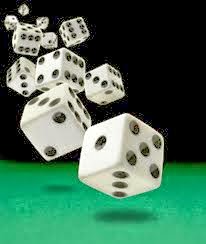
Crapshoot

Crapshoot: noun. A risky or uncertain matter. See also: Life

Okay, so I added that last part, but it’s true. Every single action we take or decision we make is a roll of the cosmic dice which determines and alters the course of the rest of our lives. Most of the changes are like tiny ripples on the surface of our lives, but some.…

The instances and effects of significant life-changing decisions or actions…the majority of them totally spontaneous…are mind boggling. If, when I was five years old, I had not jumped down a small embankment to watch a passing train, the little girl who, not seeing me there, also jumped down the embankment, landing on and breaking my leg, would I have been so acutely aware for the rest of my life of not doing things or taking risks that might cause me physical harm?

If, at around age seven, I had not gone to a birthday party at which the mother of the guest of honor insisted the guests pair up, boy-girl, and dance, would I forever since have been so aware of my lack of physical grace and subsequently refused to do anything that might demonstrate that fact?

If, while flying in formation on a night training flight while in the NavCads, I had noticed the miscalculation of my airspeed and how quickly the lights of the plane ahead of me were coming closer, ten seconds later than I did—giving me time to push the nose of my plane down and passing less than 10 feet under the belly of the plane ahead—there would have been a midair collision in which I and possibly the other pilot surely would have died.

If I had told my mother’s doctor “it’s time to stop trying to save her” when he, she, and I knew it was hopeless, rather than clinging desperately to the hope that maybe some new approach might make a difference, I could have saved her untold suffering and spared myself the guilt and regret that haunt me to this day.

If I had not decided to leave Los Angeles for Pence, Wisconsin to start a Bed and Breakfast in an attempt to “save” my partner, Ray, from the temptations of alcoholism—which destroyed him despite all my efforts—I would not have set off a chain reaction of events which graced my life with several close friends who I first met as guests at the B&B—through one of whom I subsequently met my best friend Gary.

If I had not been…um…intimate…with a bisexual young man a mutual friend had convinced me to let stay at my home to help me with various projects, I would not have been exposed to the HPV virus (Human Papilloma Virus) which caused the tongue cancer which was the equivalent of a 9.0 earthquake to the structure of my life.

And these are just a very, very few examples of the crapshoot of my life: what about yours? I hope you might take a moment to look back over your own life and pick out those instants, those actions, those decisions that sent your life off on a different path than you assumed it was pursuing. 

We are totally powerless to avoid this eternal crapshoot, since it is part of life itself. And once the dice land, whatever happened or whatever we did to alter the course of our future cannot be changed, and we must live with it. The only thing we can do is perhaps take a moment to consider our actions or our decisions before we implement them.

Dorien's blogs are posted by 10 a.m. Central time every Monday and Thursday. Please take a moment to visit his website (http://www.doriengrey.com) and, if you enjoy these blogs, you might want to check out Short Circuits: a Life in Blogs (http://bit.ly/m8CSO1), which is also available as an audiobook (http://www.audible.com/pd/ref=sr_1_1?asin=B00DJAJYCS&qid=1372629062&sr=1-1).


Thursday, April 03, 2014

Fairdale


It's human nature, when hearing someone considerably older than yourself tell tales of how different distant yesterdays were from today, to roll your eyes and sigh heavily. It never occurs to us that the older have the advantage of having experienced both "then" and "now" whereas the young have only the "now" and the relatively recent past. It's difficult to comprehend just what a different world it was when the teller of stories—a parent or grandparent, usually—was younger than the listener.

For every human being, "now" is the norm. "Now" is the way it has always been and the way it will always be. Yesterday is just a footprint glimpsed directly behind us in the sands of time. Yet the more yesterdays we leave behind us, and the less distinct they become the farther away they are.

The problem with "now" is that we are too close to it to see it clearly. But the fact is that each of us grows up in a world different from that of our parents and grandparents—-just as our world today will be equally different from the world of our children.  

And thus the subject of this blog. 

I was thinking yesterday—as always, with me, for absolutely no reason—of my own distant yesterdays and a town which by it very name conjures up a long-gone rural Midwest America: Fairdale. 

In the mid-to-late 1930s my grandfather and his wife owned and lived in a combination bar and gas station in Fairdale, Illinois, one of those tiny unincorporated hamlets quaintly but often accurately referred to as a "wide spot in the road." It was located on far-from-busy Hwy 72, which connected with the far busier Hwy 51 which cuts vertically through the center of Wisconsin and Illinois . It was probably less than 25 miles from my hometown of Rockford, but seemed like hundreds of miles—and decades in time—from anywhere.

I first checked Google to see if Fairdale still exists (surprisingly, it does), and then sought a map for it's exact location. I see it has a total of three very short streets, each no more than one-or-two-block-long, The longest, and only one I can remember, had once served as the town's "main street." It ran north and south between Hwy 72 and the railroad tracks. Clustered along the end nearest the railroad tracks were perhaps three or four even-then-long-abandoned 2-story once-commercial buildings, but as I recall, Grandpa's bar/gas station was the only business in the town.

The bar, too, was old even then, a typical small farm-town bar which smelled of cigarette and cigar smoke and spilled beer and whiskey. Once, when I was "helping" Grandpa sweep up in the morning before the bar opened, I found a $5 bill someone had dropped. A $5 bill in the mid-to-late 1930s was a very great amount of money, indeed, and when no one returned to claim it, Grandpa let me keep it.

Neither the bar nor the gas station made much money. This was a very rural area, and the effects of the Great Depression still bore heavily on all aspects of the lives of average people.

Just east of Grandpa's place, on the highway, was Fairdale’s one-room school, which I remember primarily because its playground had one of those metal self-propelled "merry-go-rounds" you can still occasionally find today, which kids would start by pushing it in one direction, running faster and faster until they could jump on and go round and round until the centrifugal force died and it slowed to a halt. Then you jumped off and started the process over again.

Across the street from the school was a large farm with a large—to the eyes of a 5 year old kid, huge—barn. I can still close my eyes and smell the hay. The family that owned it had a couple of kids around my age, and we would sneak into the barn, climb up into the hayloft, and then ascend a ladder to a small platform almost to the barn's rafters. It seemed like a very great height, but was probably eight feet at most. We would then jump down into the hay, shrieking with laughter and the sense of excitement such courage warranted.

It was, indeed, a different time and a different world, with different values and attitudes, and the more harsh realities of life at the time gradually grow less distinct as the fog of time closes in. Sharper edges dim and soften, and nostalgia paints memories in softer colors, making the past often more appealing than the "now."

But man is a creature which craves comfort, and if memories of a tiny town long ago can provide me with some comfort, I'll savor it like a fine, vintage wine.

Dorien's blogs are posted by 10 a.m. Central time every Monday and Thursday. Please take a moment to visit his website (http://www.doriengrey.com) and, if you enjoy these blogs, you might want to check out Short Circuits: a Life in Blogs (http://bit.ly/m8CSO1), which is also available as an audiobook (http://www.audible.com/pd/ref=sr_1_1?asin=B00DJAJYCS&qid=1372629062&sr=1-1).